
Do You Think a Lot of Modern Art is Bullshit? (Copy)
Let Us Count the Ways
Audio by Sound Legacy
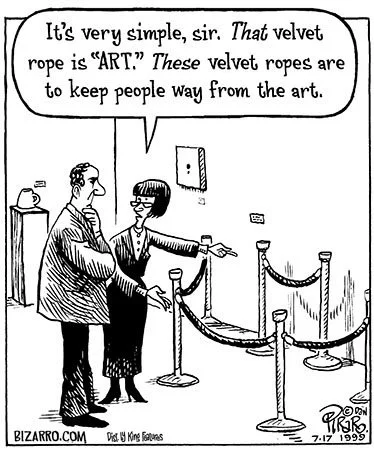
Michelangelo takes a chunk of rock from a mountainside and turns it into a heart-wrenching depiction of a mother grieving over the lifeless body of her son; Jackson Pollock tapes a canvas to the floor and splatters paint all over it. Are they both “art”?
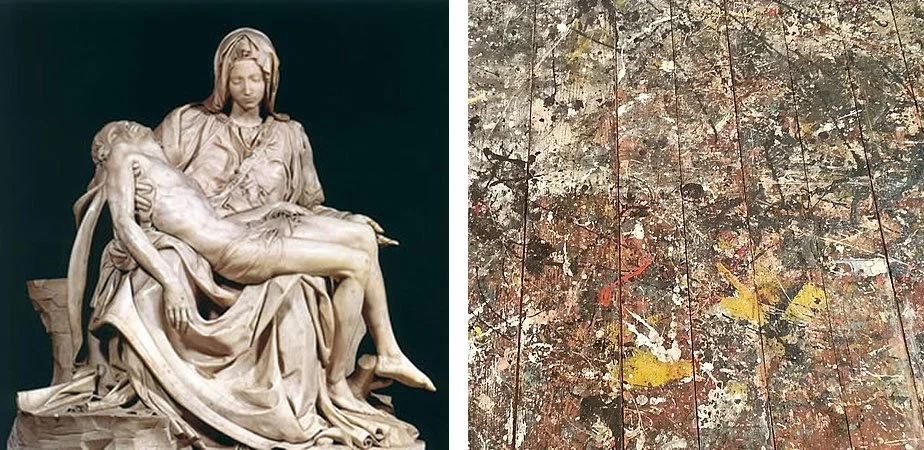
The Pietà, left; the floor of Jackson Pollock’s studio, right.
As a teenager, I had a button on my jacket that said, “If your mom likes it, it isn’t art.” I still admire the rebellious nature of that expression, but how true is it?
Michelangelo’s mother loved his Sistine Chapel ceiling (or so she told me during an acid trip I took in high school), as have many millions of people for over 500 years.
On the other hand, Google says Pollock’s mother was an artist and his biggest champion until he began doing his drip paintings, which she called “craziness.”
Maybe Pollock also had that button and just kept experimenting until his mother disapproved. It certainly paid off for him financially, but will people be drawn to Pollock’s drop cloths in 500 years?
For my money, Renaissance Mike’s mom had better taste. What do you think?
Is Some Art Bullshit?
Distinguishing “good art” from “bad art” is a bottomless pit of subjectivity.
Unlike most articles on this topic, I’m neither going to defend modern art nor rip it a new one, as much as I’d sometimes like to. Instead, I’ll just poke fun at it with comics and let you decide. In the end, that’s what art is anyway: a personal preference.
We are all different, and nothing demonstrates that better than art.
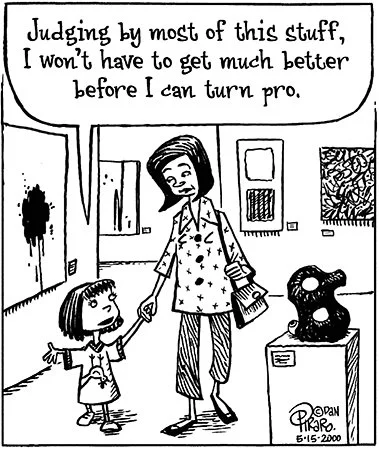
I don’t mean to say that all modern art is not to my liking, far from it. But after a successful 40-plus-year career in comics and fine art, I’m no longer afraid to say that some of the emperors of the art world have been buck naked. That’s just my opinion, which is worth far less than a Jackson Pollock painting.
What Is Art?
That’s a trick question, because the topic is too broad to be defined in any useful way.
Are you familiar with “conceptual art”? That’s when the idea of the work takes precedence over the visual thing that represents it. A very famous example is a banana taped to a wall.
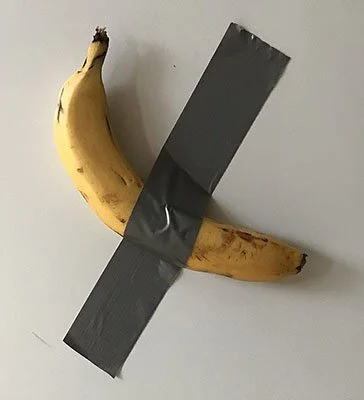
The original banana taped to a wall was sold at a Sotheby’s auction in New York for $6.2 million. (True.) That makes it “art.” The photo above is a replica taken by someone who taped a banana to their fridge as a reminder to eat less meat. That makes it satire.
Conceptual art comes in innumerable forms and often exists primarily as a challenge to what people think art is. And for me, that’s where it gets interesting.
Though I couldn’t care less about the taped banana as “art,” the fact that it was taken seriously enough to be auctioned at Sotheby’s goes a long way toward proving that art can’t be defined. It could be anything created by any human. Or not. Who knows?
So, a more practical question is, “What do you look for in art?”
Now we’re getting somewhere.
Many people want art to be pretty. That’s how Thomas Kinkade made enough money to spend $6.2 million on a piece of fruit taped to a wall (though he was not the person who did that).
Others are more interested in what art means than what it looks like.
And some, like the yahoo who bought the world’s most expensive banana, use art to show how rich they are.
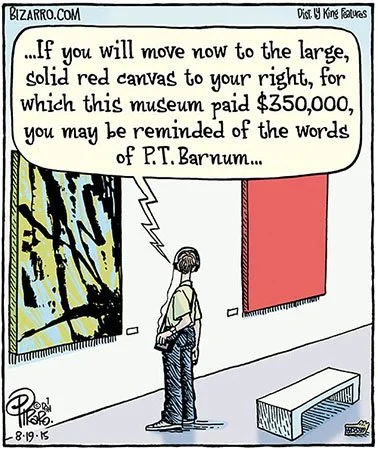
“There’s a sucker born every minute.” — falsely attributed to P. T. Barnum, but said about the popularity of his exhibits
Here’s where I think you can begin to tell if the emperor has no clothes.
It would go a long way toward convincing me that Pollock’s drippy dribbles were a legitimate art form if many other artists had been able to forge careers in that style, as Impressionism, Cubism, Surrealism, and abstract art have made many artists famous. But that isn’t so with Pollock’s “craziness.” He’s the only one who got away with it. (However, check out the paintings of Janet Sobel, whom Pollock was doubtless imitating but who never achieved his fame. Being female in a patriarchy was probably her biggest mistake.)
What Do You Look for in Art?
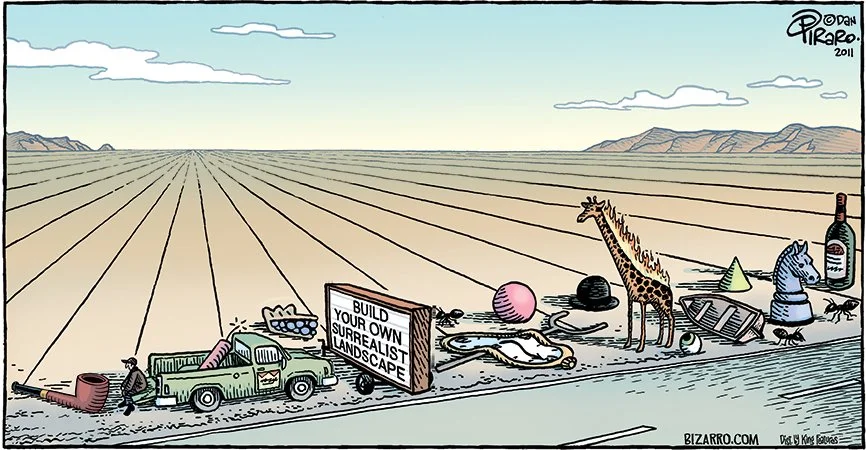
I like art to be interesting visually and to make me think. It doesn’t have to include an obvious message; in fact, it’s better if it leads my mind to places unknown and unintended by the artist. That’s what I love about surrealism. Like a convoluted dream about flying shoes or a visitation from a fish in a tuxedo, surrealism can feel like it means something, but you have to search your own psyche to figure out what.
Does it Matter?
No. In the big picture, it doesn’t matter what’s “art” and what isn’t, who created it, or how much money you spent on it. What matters is surrounding yourself with things you enjoy.
I used to be afraid to express my opinions about certain kinds of modern art for fear I’d be seen as unsophisticated. I no longer care enough about my reputation to fake it, so I’ll freely admit that I do not see the value of many kinds of modern art—other than for investment purposes—which I think degrades the cultural importance of art.
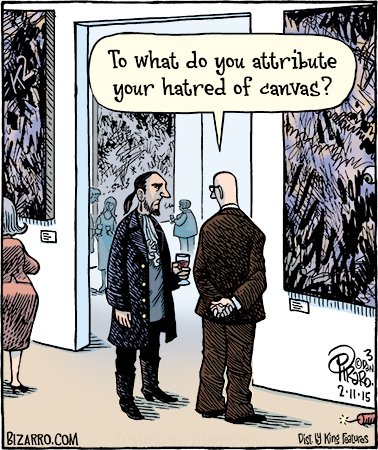
The craziness started after Picasso and Braque shook things up by inventing Cubism, and it was not long before the fine art world tossed out all concepts of convention and became a race to see who could do something no one else had done before. It morphed into an “anything goes” industry, and if you were in the right place at the right time, you could get famous for anything, as long as you did it first and the right collector liked it. That’s how Pollock got rich.
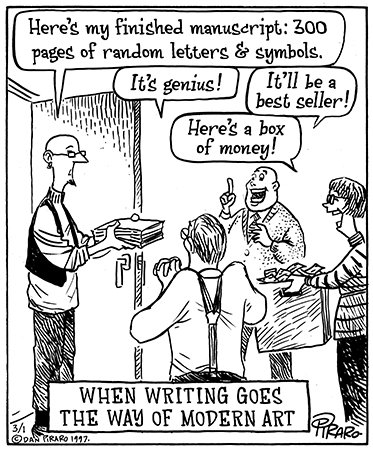
I certainly would not want to limit what can be considered art, but imagine if other forms of creativity indulged in the same ethos.
Who’s the Banana Now?
I once visited the Museum of Modern Art in NYC and witnessed a crowd of people gathered around an artist named Marina Abramovic as she sat motionless in a chair for many hours. Members of the viewing public were encouraged to sit across from her and look her in the eyes. The piece was called “The Artist is Present.” This sort of thing falls under the category of “performance art.”
I suppose it made a statement about the power of celebrity, or the weirdness of staring into the eyes of a stranger, but so what? You can experience that even more intensely on the Subway if you’re rude enough.
I might have liked it better if the artist had been taped to the wall, but probably not.
Where Does Art Come From?
Creativity is our species’ superpower. Our abilities in this area are endless, and have resulted in everything from great beauty to environmental destruction, from antibiotics and organ transplants to nuclear war.
I’ve created thousands of pieces of art and have spent as many hours pondering where creative inspiration comes from.
Some art is a market calculation: “This will sell.” But at other times it’s a spark of something that comes from an elusive elsewhere, a tiny voice from another dimension. Learning to listen to that voice can be the difference between mediocrity and a masterpiece.
Yes, that sounds mystical, but sometimes being an artist is just a paint-splattered smock away from being a shaman. It can be an exhilarating act of magic that results in something you never saw coming.
Whatever the case, human creativity is the greatest creator and destroyer the world has ever known. Using it to create art, music, literature, or hilarious TikTok videos is one of the most gratifying activities life has to offer. I highly recommend it, wherever it leads you.
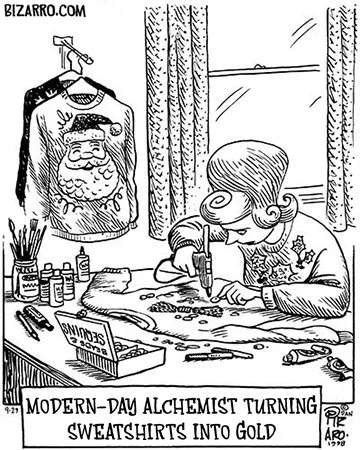
My mom’s creativity was in crafts, including sequin-bedecked holiday sweatshirts, and she sold them at craft fairs. They weren’t the sort of thing that Sotheby’s would be interested in, but it made her happy.
Cutting to the Chase
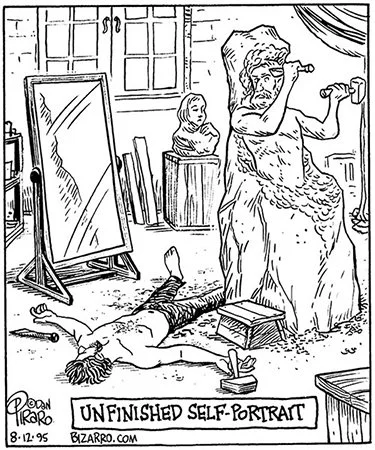
Enough of my know-it-all bullshit; let’s review some more of my comics about art.
Trigger warning: Some may be as dull as Abramovic’s chair performance, and none are worthy of the Sistine Chapel ceiling. Especially the one that parodies it.
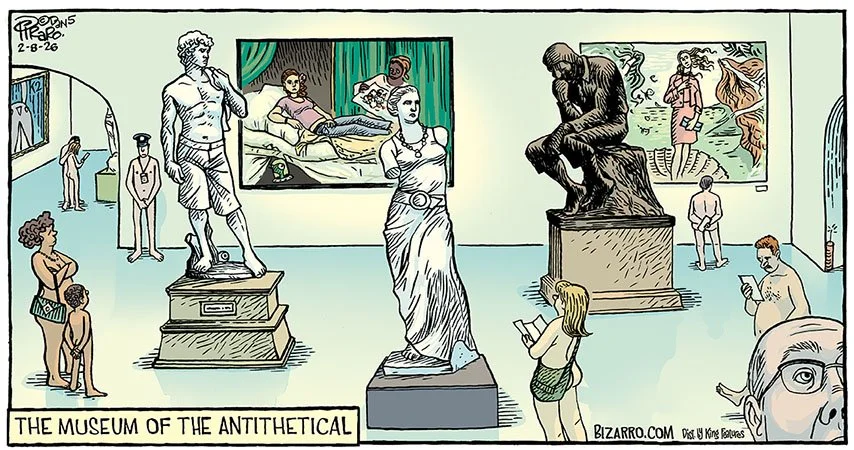
I’m as modest as most average folks, but it amazes me that some people are so terrified of nudity that they will object even to a stone or bronze version of it. This is much more common in the puritanical U.S. than in Europe.
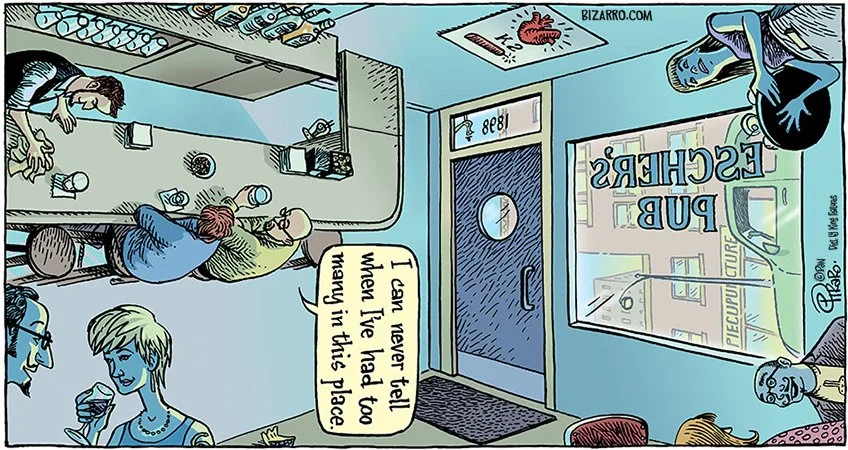
Even before I became a stoner, I fell madly in love with the art of M. C. Escher, and the romance has never subsided. I’ve published around a dozen cartoons parodying his work, and this one is my favorite. (That’s a cameo appearance by my wife and me in the lower left corner, and a caricature of Escher as the bartender.)
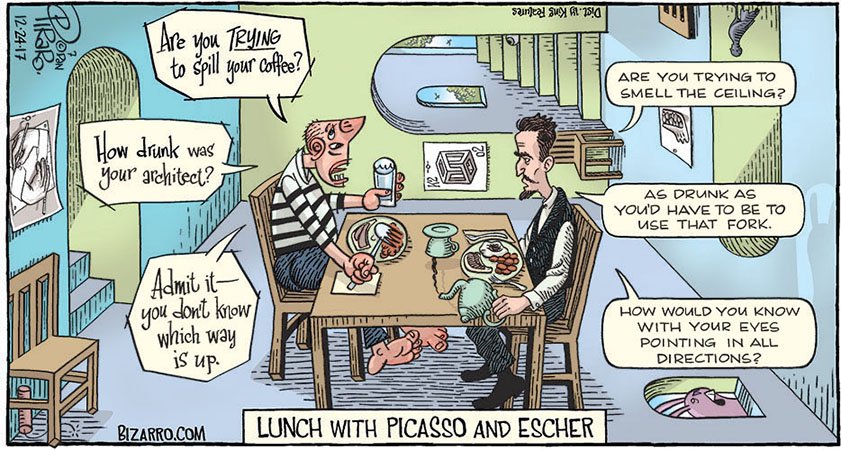
Here, Picasso and Escher trade friendly jibes over a meal. (This one is best read left-right, left-right.)
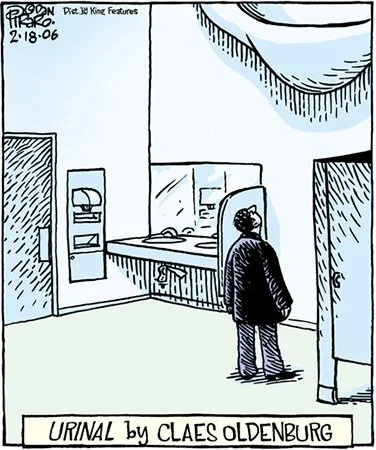
Oldenburg was most famous for creating enormous versions of everyday objects. I like that his sculptures make me contemplate the importance of relativity and how minuscule I am in relation to the cosmos. But mostly, it’s just fun to see a familiar object in gigantic form.
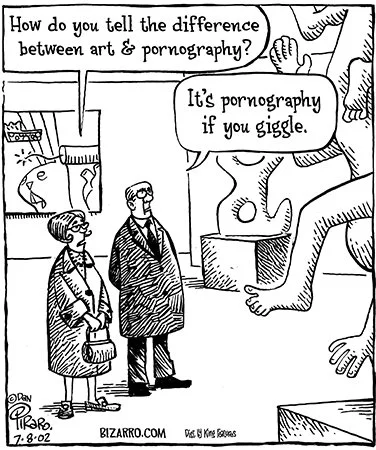
This is a good rule of thumb when visiting museums and galleries.
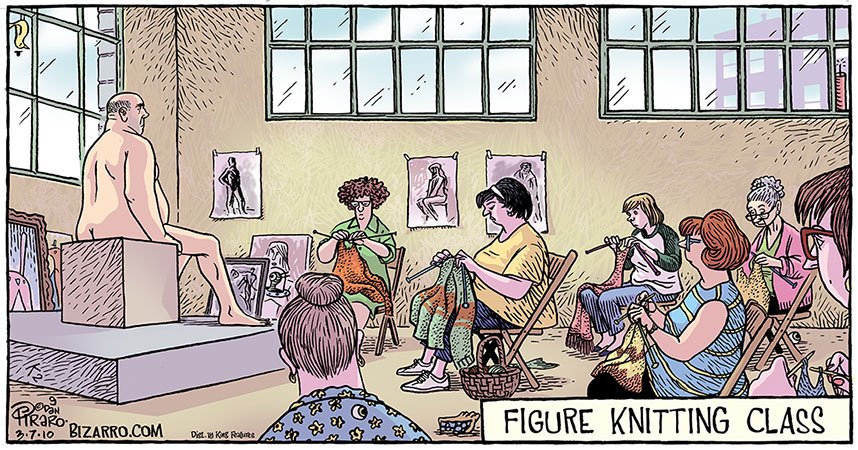
As a teenage freshman in art school, I was both shocked that there were people who could sit naked in front of a roomful of strangers without blushing and disappointed that none of them was attractive. I quit school after one semester, but at least I got this cartoon from the experience.
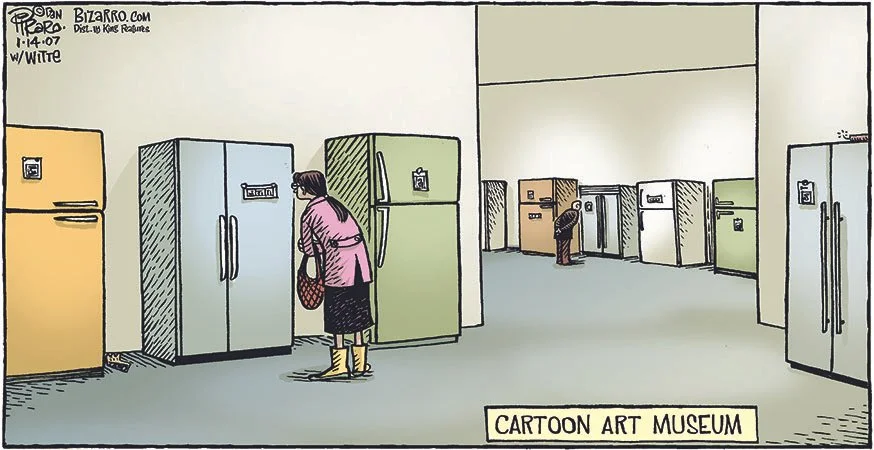
Cartoons are more likely to be found on refrigerators than in museums. I’ve often thought that kitchens are cartoonists’ Louvre.
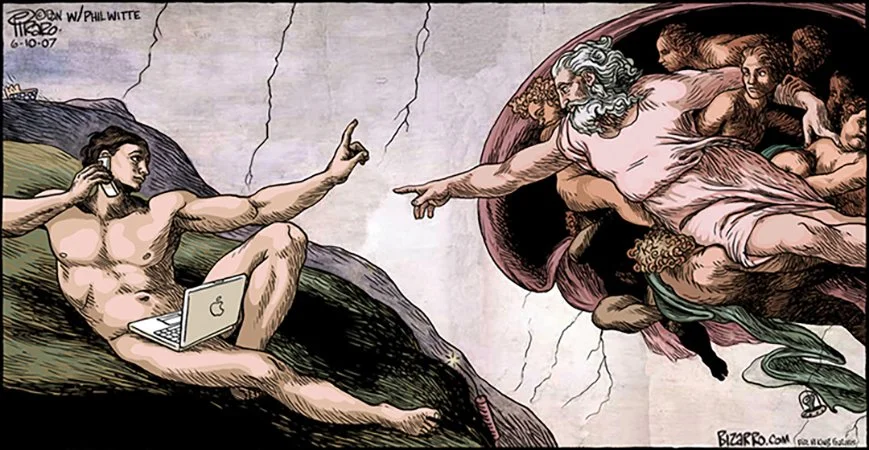
This has long been one of my favorite comics of my career. The idea was suggested by Phil Witte, a fine cartoonist in his own right. (Cartoons, Articles) I enjoyed drawing this cartoon version of Renaissance Mike’s masterpiece, though I’ve no idea if his mother would like it. I gave up acid a few years ago.
Where Does That Leave AI Art?
Machines have taken away menial chores such as laundry, math, research, and so much more. Now, AI can handle our creative efforts in the fields of writing, drawing, painting, music, design, you name it.
Which returns us to the concept of “calculated” versus “inspired” art. AI can calculate, research, and imitate in a matter of seconds, but it cannot be inspired the way a human can.
Allowing creativity to flow through me and give birth to something new is among the most gratifying experiences in life. I’d no sooner allow a machine to take that away from me than I would employ one to have sex for me, take a mushroom trip in my stead, or eat my dessert.
I’ll surrender calculating a tip to a machine, but I’ll never turn my back on the joy of creating, even if only taping a banana to a wall.
Take a peek at my graphic novel in progress: PeyoteCowboy.net.
And here’s my video inviting you to become a supporter of Peyote Cowboy.
If you’re enjoying my articles in The Naked Cartoonist, please recommend it to your friends. If you’re not, recommend it to your enemies. Either way, you can send them this link: bizarro.com/signup. Thanks!